Carr Photo Album
By Conrad Krapf
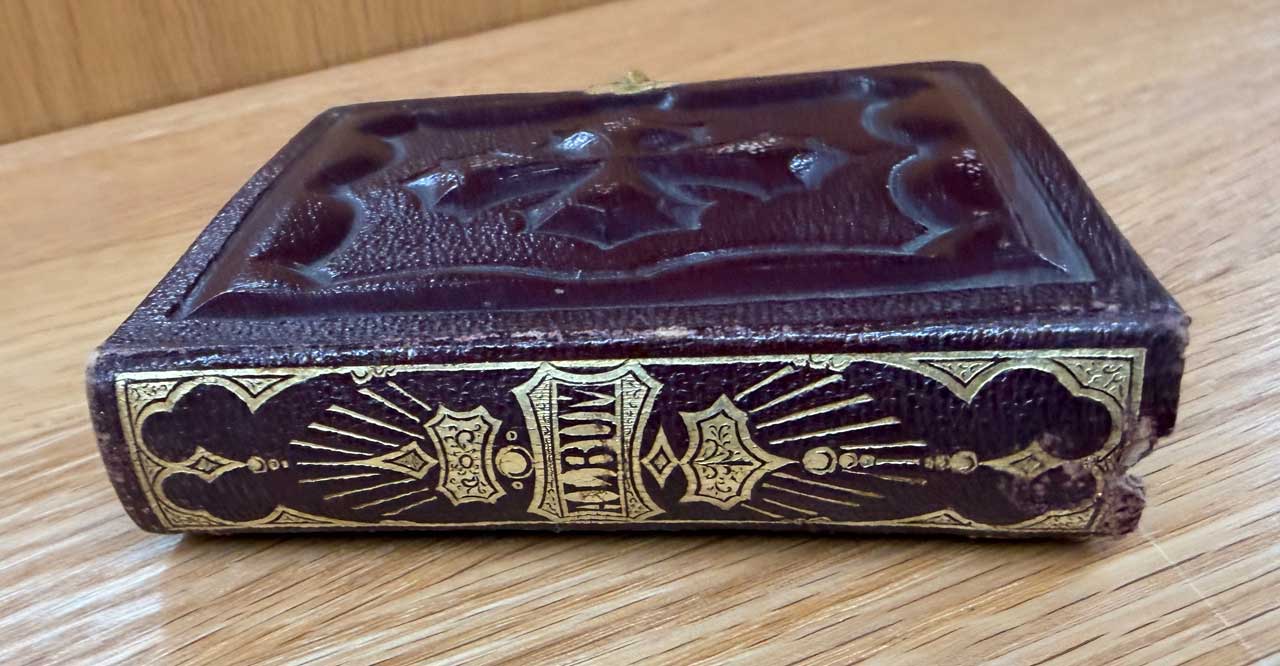
The Carr photo album has been in the Fall River Historical Society’s collection since 1985. The photos within depict several individuals who were close to Joseph Durfee Carr. The family members and close friends in the album had long been identified, but there was a large group that remained unknown, those who had attended Highland Academy, a military academy and college preparatory school in Worcester, Massachusetts. Joseph attended this school in the 1860s and clearly made enough close friends that his photo album was half full of them.
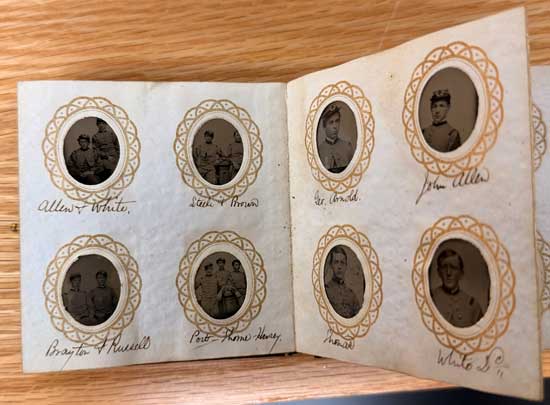
When the album was donated to our collection in 1985, the members of the Carr family within were identified by Curator Michael Martins by sight. At that point, it was just another photo album, so it went into the archives after the known people had been recorded. But at that point, thirty-five people were unidentified, so it was noted down as a future project of interest. Eventually, the curator returned to the album and managed to make some progress on it. First, he noticed that the unidentified were wearing military uniforms with “HMC” emblazoned on them. From this (and with some research of his own) he was able to identify them as likely students of Highland Military Academy, but nothing more.
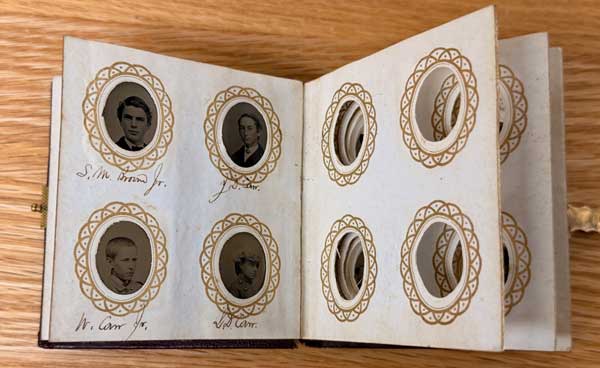
Shortly afterwards, I was hired, and the project was passed on to me. What made identification of these individuals at all possible was a small thing: Carr generally noted just the first initial and last names of each of his school friends, albeit with the occasional misspelling. After a day or two of research, I was able to find what was essentially a yearbook for the school, the Catalogue of the Officers and Cadets of Highland Military School from 1856 to 1870, which included a description of the school’s activities, as well as the aforementioned list of students who had attended the school. The students who were listed here were mostly from 1865 to 1867, with four students from 1869, just before the catalogue’s cutoff date. From this, I built a record of each student and their assorted records that I could track down on the Ancestry.com service, which was not an easy feat for everyone involved. The Catalogue is not an extensive document and only reports the full names and cities of origin for each student. Luckily, with this information, I could attempt to identify everyone using Ancestry.
The first step was to correlate the year of graduation with a potential birth date, which did not always align. From there, a search on Ancestry could be done, as many of the students had names that were common for the 19th century, such as “Frederick Long” or “William Brown.” Attempting to search one of those names without being able to narrow down with the place of origin and likely birth date is a fool’s errand.
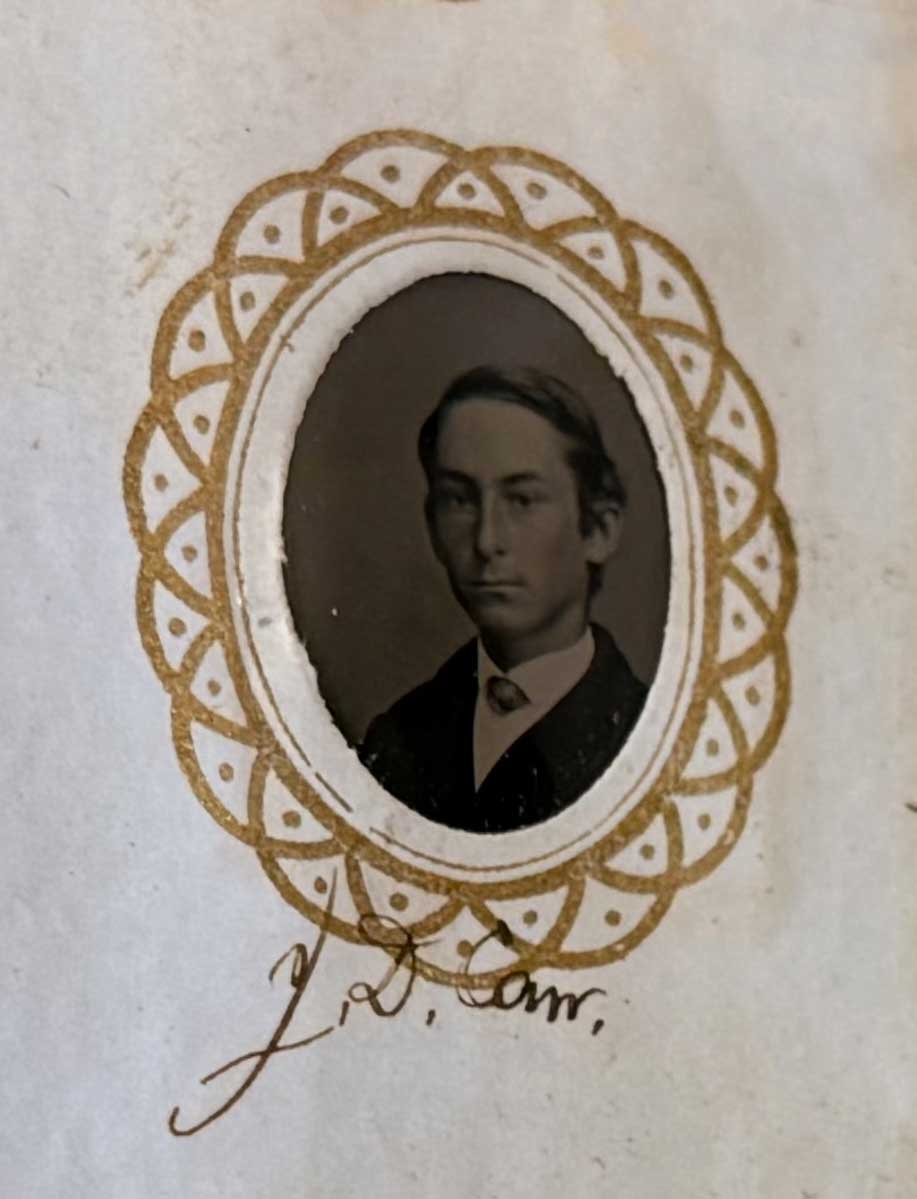
While I was able to positively identify twenty-two students, the other thirteen had issues. For some, there was no record on Ancestry, and I could only show that they were in the album and the Catalogue. Others had pages on Ancestry, but living descendants had set them to private, meaning that while I was relatively certain that I had a positive identification, I was unable to verify them. One student simply did not have a name written under his portrait, which means that there was no way to identify him. Perhaps the most amusing problem was a student by the last name of “Turner.” In the Catalogue, two different boys with the last name “Turner” appear, Miles Turner and Azro Turner, one from North Scituate and the other from South Scituate! Neither seems to have left much of a record after graduating, so I was unable to tell who was depicted in the photo, other than that his last name was “Turner.”
Identifying everyone took about a month and a half, most of that time spent trying to track down biographical information about each of the students. Matching names to faces was the first step, but I had to do more to fulfill my own goals.
THE HIGHLAND MILITARY ACADEMY
The Highland Military Academy was founded in Worcester in 1856 with the aim to provide a new class of officers for the burgeoning United States military, as well as a class of college students that would be well prepared to eventually run the nation, an educated and disciplined élite of moral and intelligent men. New England, and especially Massachusetts, was rife with this sort of preparatory school during the 1800s, such as St. Mark’s School in Southborough, the Groton School in Groton, and Middlesex School in Middlesex.
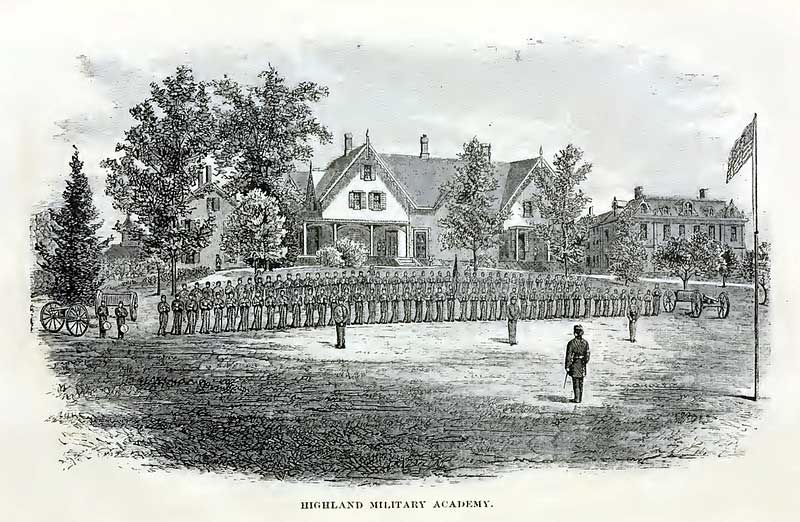
From Worcester Illustrated, James Arthur Ambler, 1875.
What must be understood about secondary education in the 1800s is that it was much more of an equivalent to modern-day college than the current system. Firstly, there was something of a difference between a high school and a college preparatory school. College attendance in the 1800s was very low, with the 1900 census finding that only 1-in-50 Americans had attended college. If you were fortunate enough to have completed a standard secondary education, it was expected that you would go on to work as a clerk, treasurer, or some other such position within the small but growing American intellectual class. If you attended a preparatory school, however, it was expected that you would go on to college and likely become a member of the burgeoning American elite. Of course, if you were attending prep school, it was much more likely that you were already a member of the elite.
A white day-laborer in Massachusetts in 1860 made about a dollar a day and, within a decade, that amount would only reach $1.62. To afford the Highland Military Academy’s $430 yearly price tag (payable in two easy payments of $215 a semester), you would have to already be quite wealthy. This was also the base price. If your son took an interest in music, chemistry, riding lessons, or even modern languages, you would have to pay up. For a full year’s lessons, music was $70, chemistry or a course of fifty riding lessons $50 each, and each modern language was $30, for which the student could learn French, German, or Italian. Plus $23.50 for room and board if you stayed on campus over vacation. For a student who wished to take the full roster of courses, you could spend $600.50 per year, essentially the same price as similar schools such as Groton, which cost $500 in its first few years, quickly rising to $600.
The military nature of the school cannot be discounted. The students slept on campus, learned on campus, exercised on campus, and only went home for vacations. The usual length of attendance was three years, although they had a sort of primary education class for students who were not up to standards, and a post-graduate class with more advanced topics. As it was ostensibly a military school, they also had a chain-of-command system amongst the students who acted as officers, both commissioned and non-commissioned. This was, as far as I can tell, essentially unique for the region and time period. Your student would take a course on artillery, parade drill, cavalry maneuvers, as well as calisthenics, to prepare him for a career in the military, or some other field. Make no mistake, this was a school that produced elites.
CHARLES HERBERT ALLEN
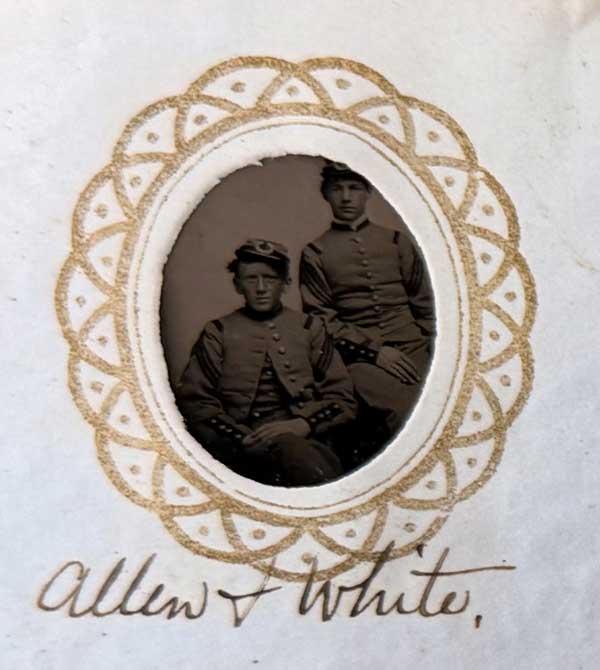
What kind of student was produced by Highland Military Academy and other such preparatory schools? Well, in the photo album, we have a perfect example of the sort of high-powered man who resulted. Charles Herbert Allen would lead an influential life. The son of Otis and Louisa (Bixby) Allen, he was born on April 15, 1848, and attended the Highland Military Academy as a member of the class of 1865. He later graduated from Amherst College with a Bachelor of Arts in 1869 and a Master of Arts in 1872.
Allen wore many hats in his career, from a lumber manufacturer working under his father, to a state and federal politician, and a soldier. His political career started in Massachusetts as a representative in 1882-83, then rising to state senator in 1884. Following that, he was a member of Governor George Robinson’s cabinet, holding the rank of Colonel at the time (Robinson would go on to be a defense attorney for Lizzie A. Borden). Soon afterwards, he ran for Governor as a Republican but lost in 1891, becoming the state prison commissioner. He succeeded Theodore Roosevelt as Assistant Secretary of the Navy for four years, until 1901. Finally, he finished his public service as the first civilian Governor of Puerto Rico in 1900 and held both the position of assistant secretary and governor for a full year before retiring.
As the Governor of Puerto Rico, a position he held for about a year, Allen created a rail network and invested significantly in sugar plantations on the island. He would retire from the position in 1901 and take up positions as vice president of both the Guaranty Trust Company of New York and the Morgan Trust Company, which would grow into the company known as J.P. Morgan and Company today. In that role, he acted as a key figure in the creation of the American Sugar Refining Company, also known as the Sugar Trust, which controlled 98% of sugar production in America by 1907. His connections in Puerto Rico allowed him significant benefits for the burgeoning trust and would help him in the various positions he held. Allen served as its treasurer, president, and then board member from 1910 to 1915; the organization would continue to grow, eventually becoming Domino Sugar.
He married Harriet Coleman Dean in 1870, and would have two daughters, Bertha and Louise Allen. Louise’s son would go on to be a hydrographer and 32nd Governor of American Samoa from 1944 to 1945, continuing the family tradition of going from naval officer to appointed governor. The house that the elder Allen retired to in Lowell, Massachusetts, was eventually donated to UMass Lowell, where it is now known as the Allen House and acts as an art gallery and Honors College building.
THE GEM-SIZED TINYPE
Photography is a fascinating art and over the years it has evolved from the daguerreotype that captured Lincoln to digital cameras that snap away at President Trump, all the way to the tiny digital systems embedded in smartphones. The Carr album is a great snapshot (aha) of one step in that evolution, the gem-sized tintype photograph.
Tintypes came about in 1853, invented in Paris by Adolphe-Alexander Martin. Called a “ferrotype” at the time, it made its way around the world until it reached the United States, peaking in popularity in the 1860s and ‘70s. Compared to the daguerreotype, it was a significant improvement in practically every field, because producing a tintype was much less dangerous than the daguerreotype. The daguerreotype process required a near-pure silver surface, either totally silver or plated, which had a mirror finish. This required significant polishing during the manufacturing, as well as immediately before use. A preparation of fumed halogens, initially iodine but later including bromine and chlorine, acted to prime a daguerreotype slide immediately before use, meaning that a daguerreotypist would be exposing themselves to immensely toxic fumes regularly. After taking the daguerreotype, in order to develop the image, the slide would have to be exposed to mercury fumes for several minutes, perhaps the most toxic step. All in all, the process was finicky, produced incredibly fragile images, and was highly dangerous to the daguerreotypist’s health.
Now, compare this to the tintype. Two processes were developed, first the “wet collodion,” invented in 1848 by chemist Frederick Scott Archer, then the “dry collodion,” invented in 1871 by Dr. Richard Leach Maddox. The wet collodion process worked through a fluid suspension of silver halide crystals on a metal sheet, which would be exposed to light and react by darkening. Once the photo had been taken, the most dangerous step followed, fixing the image by applying a solution of potassium cyanide. This would dissolve the silver that had not been exposed to light, and prevent the remaining material from reacting to light, finishing the image. The dry collodion was similar but used a gelatin suspension rather than the fluid suspension of the wet collodion, which made a hardier and easier-to-prepare slide. It was also a faster process for the portrait sitters. The amount of exposure time required for a tintype was between 8-20 seconds, compared to the daguerreotype, which had exposure times as long as eight hours, and as short as under a minute, depending on the light conditions.
Tintypes worked differently than daguerreotypes, as well as most other photographic processes, even those that came later. When one sees a tintype, you might notice that the image is actually reversed. This is because the image that is created is a photographic negative. Essentially, the first step of preparing the slide is lacquering the base before the collodion is applied, creating a deep black surface. The silver halide crystalizes on exposure to light and forms a silver-grey reflective image, then is washed away by the cyanide in areas which have not been exposed, revealing the dark surface and creating an illusion of shadow or blank space. Thus, whereas a daguerreotype is a negative that is inverted through chemical exposure, a tintype is a negative that is inverted by an illusion, a trick of reflection.
Tintypes only had a short period of prominence, about a decade, as albumen prints quickly replaced them. Albumen printing had three advantages. Firstly, it was cheaper, as it was primarily produced on paper. Secondly, it could be copied with perfect quality, unlike tintypes, which required finicky apparatuses to create multiple copies. Finally, it was much less dangerous, with sodium thiosulfide being the primary chemical fixer, although the negative used to print the positive image on paper was still from the collodion process, so there was the possibility of cyanide being necessary. While albumen prints quickly overtook tintypes, the process did not disappear, as itinerant photographers would operate into the first half of the 20th century, usually as carnival or travelling photographers. The quality and durability of the process made tintypes especially suited for the American frontier, where albumen prints would degrade quickly, and plenty of families would want a portrait to put up on a freshly constructed mantle.
The photographs in the Carr album are gem-sized, measuring about ¾” by 1”, which was the most popular size of tintype portrait. Some were smaller, usually designed to be inserted into lockets or other pieces of jewelry, but most were sized to fit a small picture frame or, as is the case with this collection, a photo album.
Overall, the collection is a fantastic grouping of high-quality portraits, giving us a wonderful insight into the most advanced technology of the day. Today, a smartphone is practically a requirement to function in society, and everyone who has a smartphone has a camera that is significantly faster, safer, and easier to use than a daguerreotype or tintype (no cyanide or mercury fumes!). But in the middle of the 1860s, creating a permanent image in such a way was still relatively new technology.
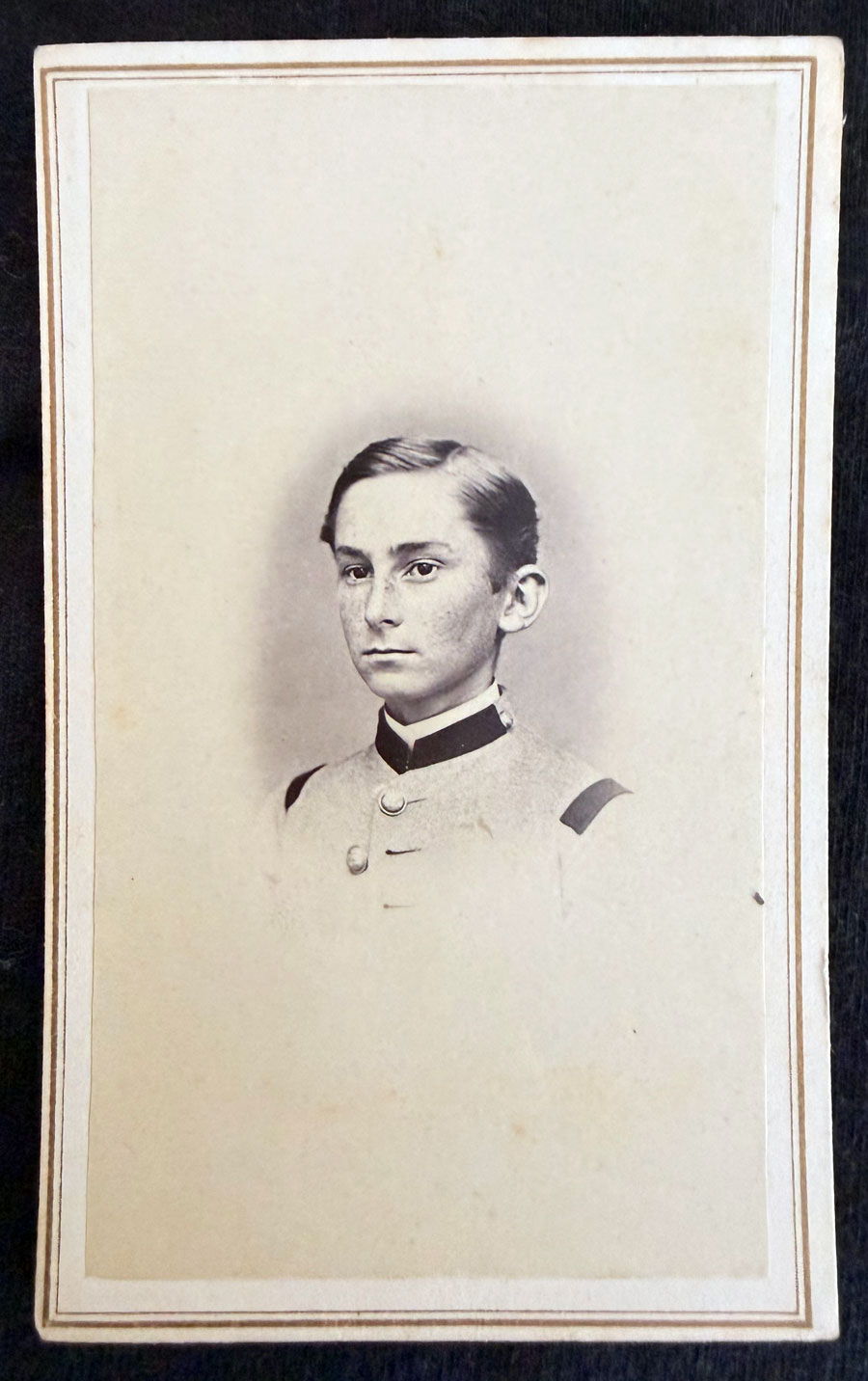
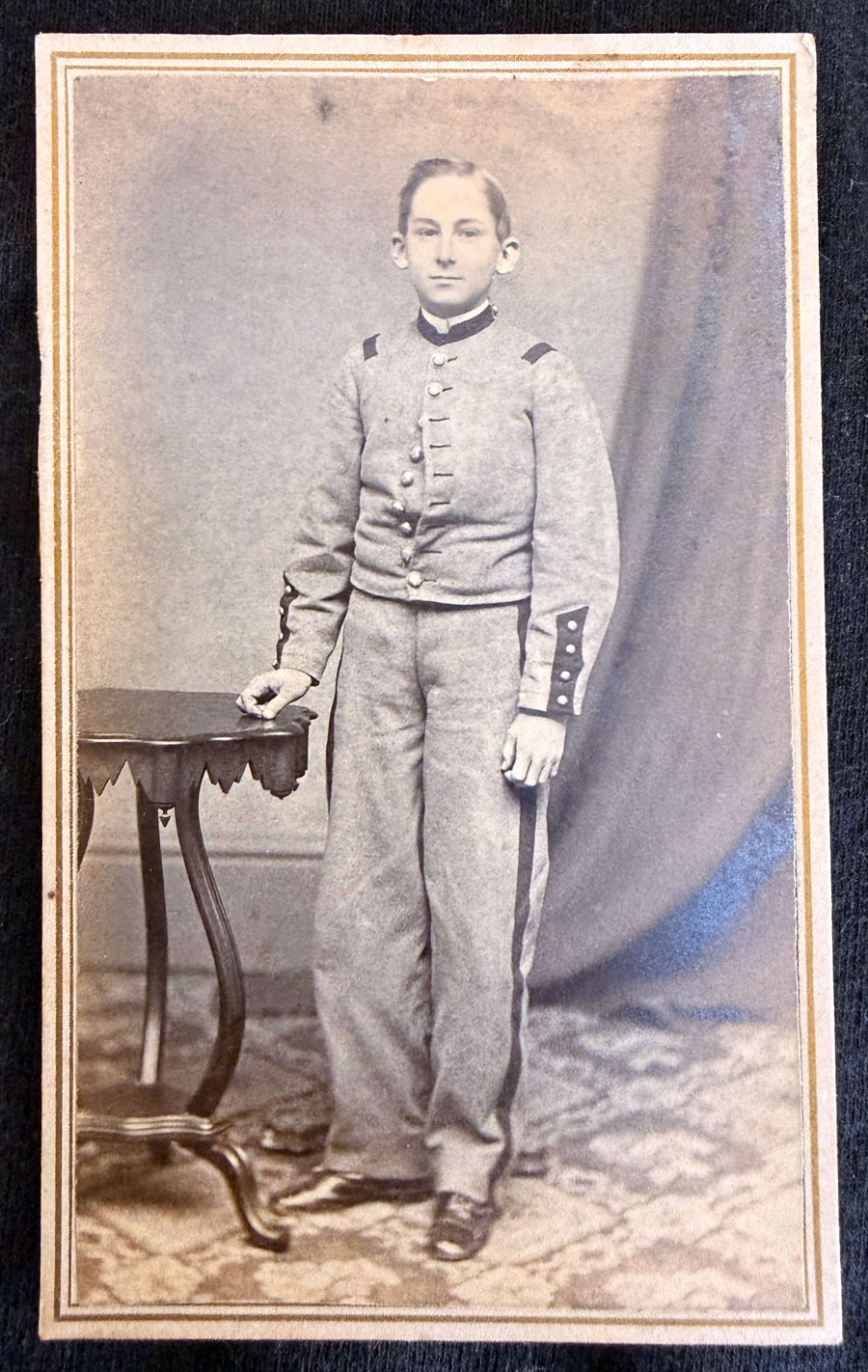
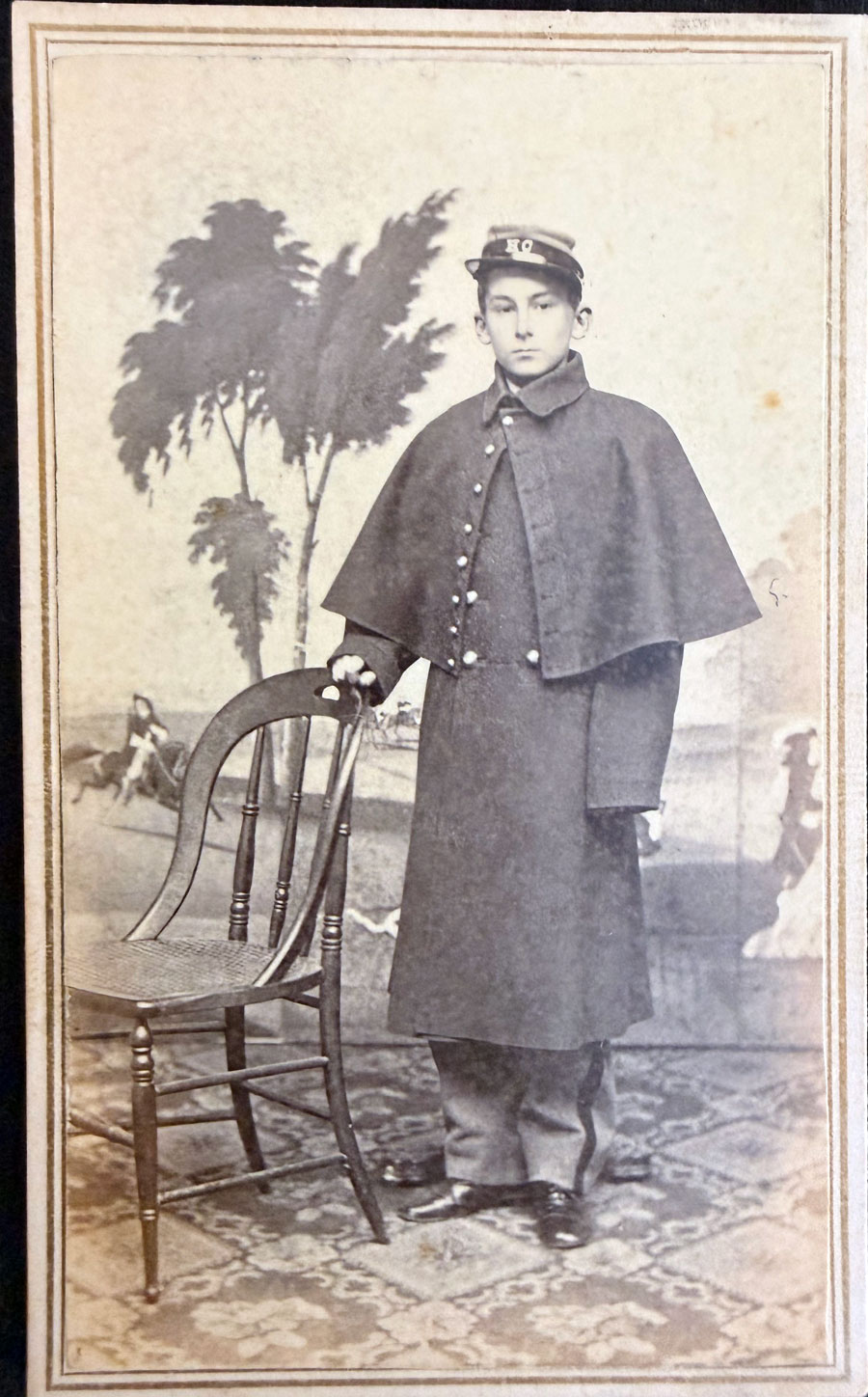
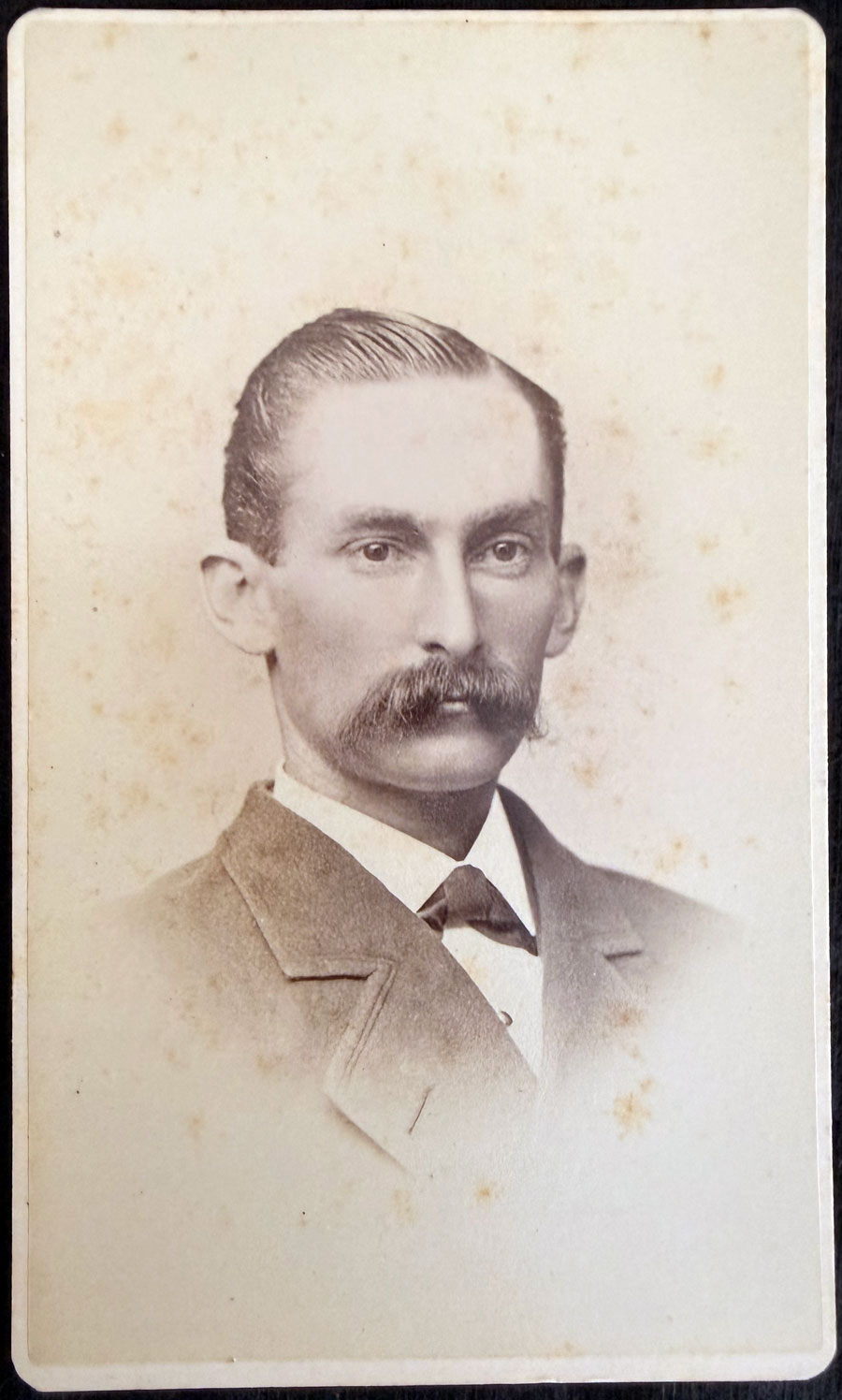
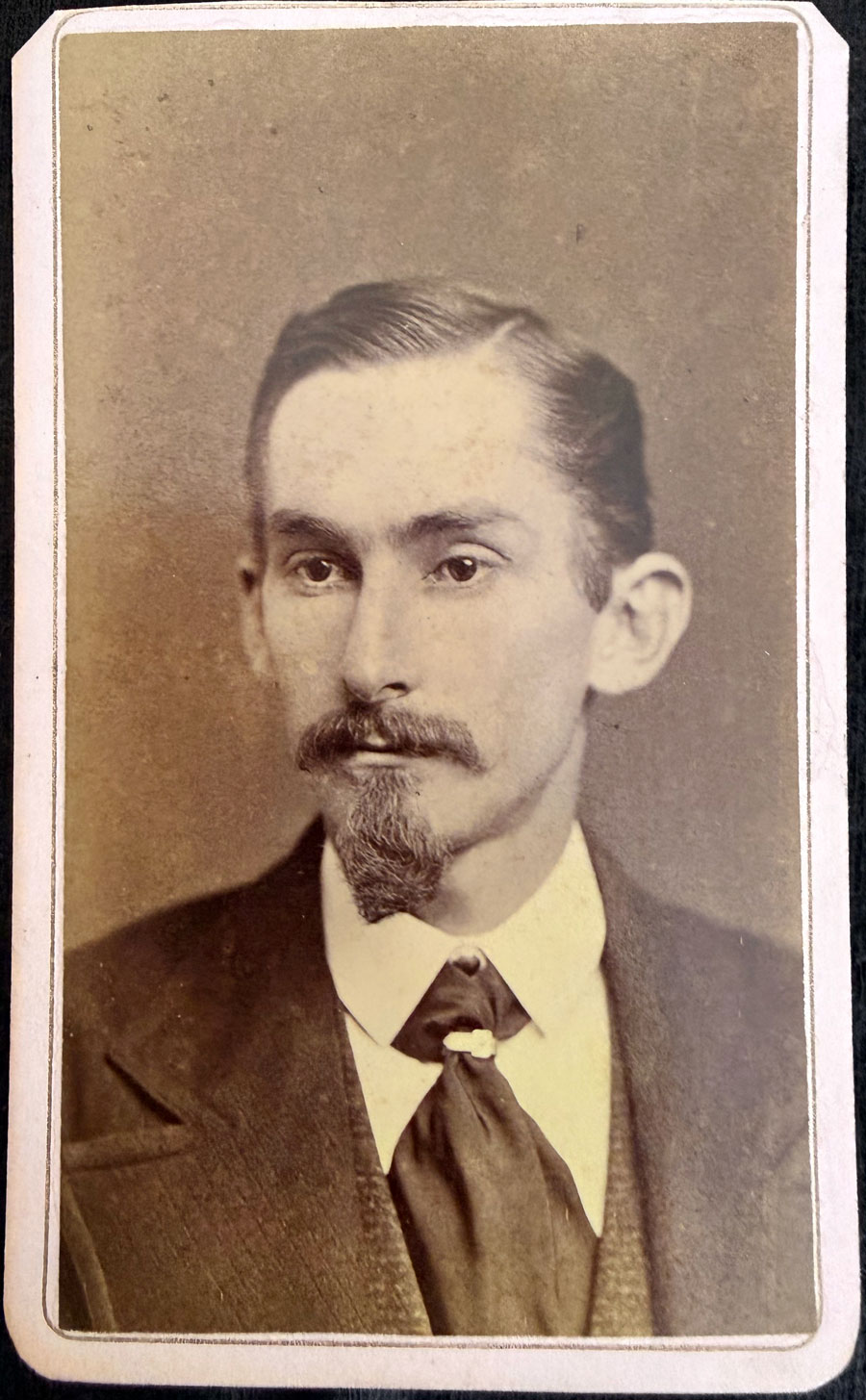
Joseph Durfee Carr, who was never physically well, would die in 1880, only 29 years old, but the images of himself, his family, and his school friends would long outlive him.